Piece 3: Marybel Balendonck
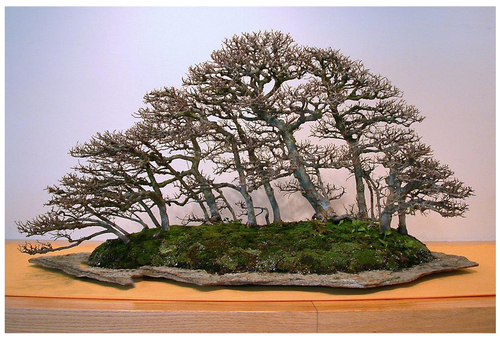 |
| Chinese Elm Forest, Marybel Balendonck. Chinese Elm. National Bonsai and Penjing Museum. Photo from NBF. |
Chinese elm is a popular choice of new bonsai artists. It tolerates a wide range of conditions and can even be grown indoors. Balendonck's forest planting is the potential result of many beginner bonsai. It has been in training since the 1970s and shows the effect of time on any bonsai.
Much like its name suggests, this bonsai isn't a single tree, but multiple. Forest plantings have rules all their own; the most important of them all is that no trunk blocks the entire trunk of a tree behind it. The canopy of the entire forest is more important than the individual trees. That being said, it's important that the individual trees don't have any major flaws.
Note that the overall canopy is slightly triangular. No tree, nor branch, breaks the silhouette. Like many forest plantings, the composition is planted on a slab instead of in a pot. Generally, pots used for forest plantings are shallow to give the illusion that the viewer is looking at a forest that's at a distance. A heavier, deeper pot tends to have more visual weight that can break the illusion.


Comments
Post a Comment